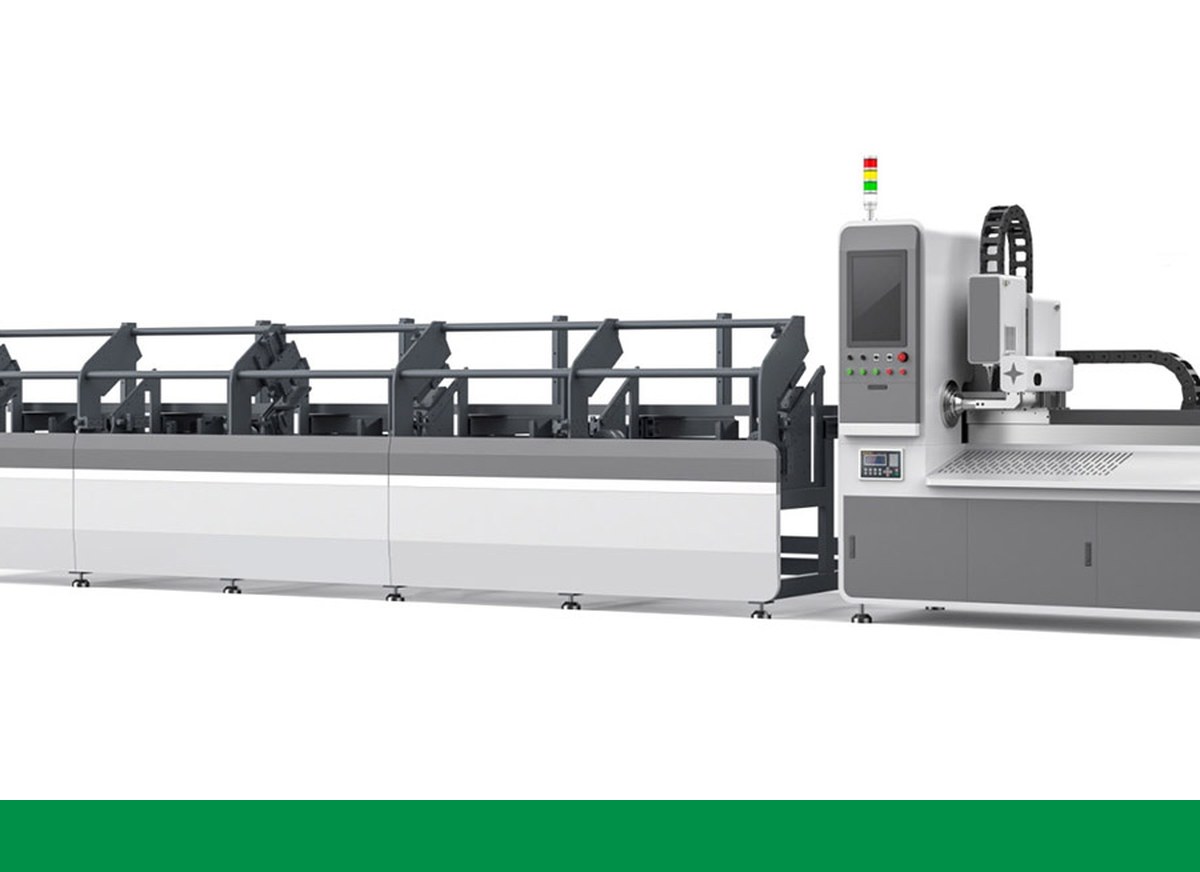
Short answer: For structural steel (H-beam, channel, heavy pipe, thick-wall sections), a pipe cutting machine (circular/cold saw or band saw) is the more cost-effective choice on a per-cut and capital basis — thick sections exceed a tube laser’s practical wall capacity and the laser’s speed advantage disappears on heavy stock. A tube laser wins only for thin-wall tube/pipe with complex contours, holes, and miters cut in one setup. Choose by wall thickness and part complexity, not by hype.
Tube lasers are brilliant on thin-wall tube (up to ~8–10 mm wall) where they cut profile and holes/miters in one clamp. On structural steel — 10 mm+ wall, H-beam, heavy pipe — the laser slows dramatically and a saw still cuts clean in seconds. The complete metal-cutting decision guide maps this boundary clearly.
| Factor | Pipe cutting machine (saw) | Tube laser |
|---|---|---|
| Max wall (practical) | Thick (no limit) | ~8–10 mm |
| H-beam / channel | Yes (band/circular) | Limited |
| Holes / contours | No (saw only) | Yes, in one setup |
| Cut speed (thick) | Seconds | Slows sharply |
| Capital cost | Low–moderate | High |
| Consumable cost/cut | Low (blade) | Higher (gas, lens, assist) |
For axis choice, see 4-axis vs 5-axis laser tube cutting. KEENSAW offers both 90° economical and 3D 5-axis lasers.
For structural steel, a circular/cold saw or a heavy band saw cuts thick-wall pipe and beam square and burr-free at a fraction of laser capital and operating cost. It does not cut holes — but for straight cutoff of structural members, that is irrelevant.

| Scenario | Cost-effective choice |
|---|---|
| Straight cutoff, thick wall, high volume | Pipe cutting machine |
| Straight cutoff, thin wall, high volume | Either (laser if holes needed) |
| Complex contour + holes, thin wall | Tube laser |
| H-beam / heavy structural | Pipe cutting machine (saw) |
A rotary tube cutting machine is a saw-class device, not a laser. The rotary cutter vs tube laser explainer clears up the terminology before you spec.
No. On structural steel (thick wall, beam), a saw is cheaper to buy and run and cuts faster.
Practically up to ~8–10 mm; beyond that a saw is faster and cheaper per cut.
Limited — lasers suit tube/pipe, not heavy structural sections. Use a band or circular saw.
LSC120-A for economical 90°, 3D 5-axis for complex contours.
A circular/cold saw or 350TS band saw for structural cutoff.
Send wall thickness, material, and whether you need holes to the KEENSAW team for a cost-effective recommendation.
Share your wall thickness, material, and whether parts need holes/contours — KEENSAW will compare pipe-cutting-machine vs tube-laser TCO on your exact jobs and recommend the cost-effective system. Request a quote →
Contact us if you have any questions we will reply as soon aspossible